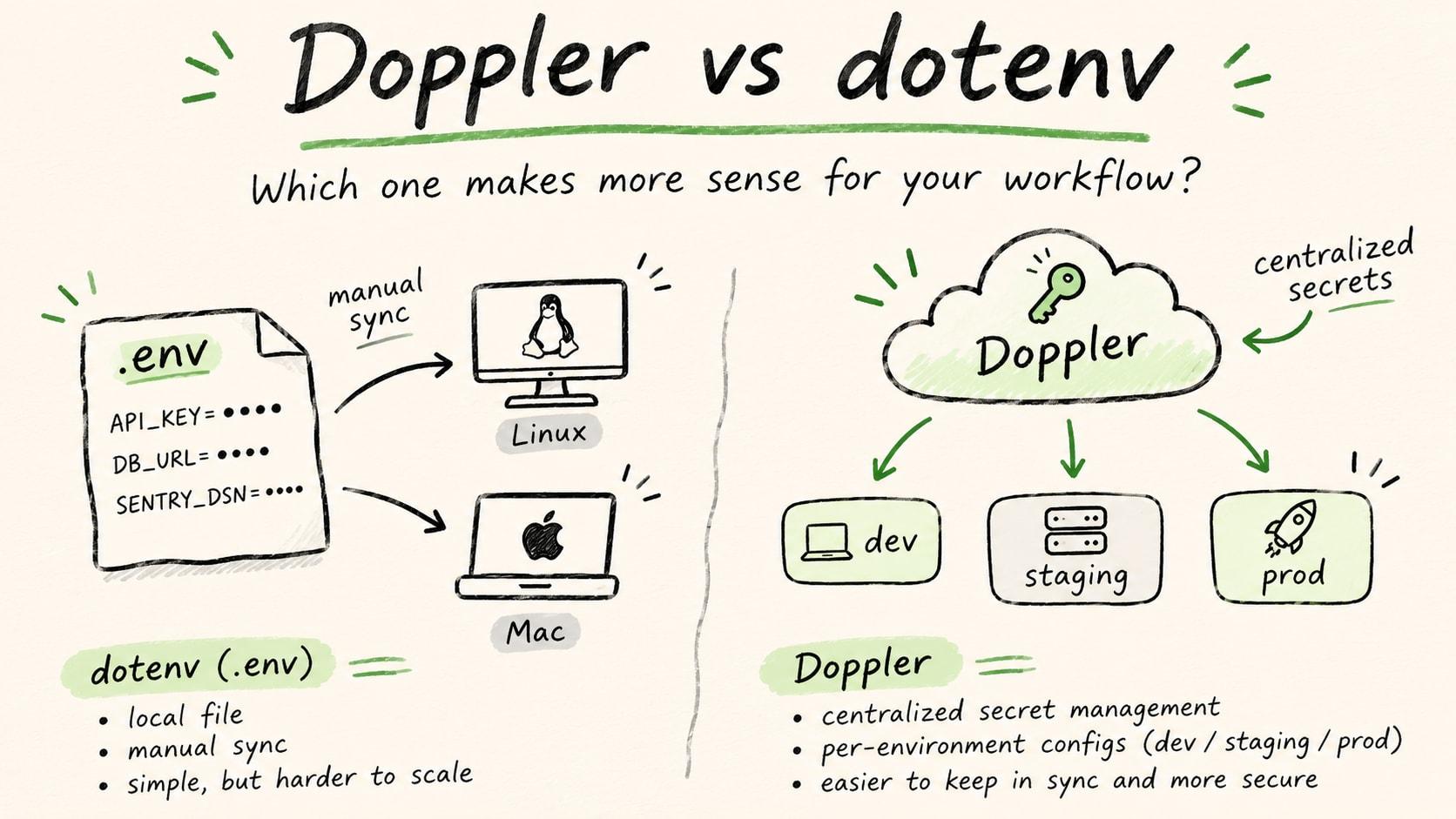
I've been using .env files for years to manage environment variables in my projects. And I don't see anything wrong with them. They're simple, easy to use, and get the job done. But recently, I started using Doppler, and it solved a problem I had been facing for a long time.
Does that mean Doppler is better than dotenv? Not necessarily. Both are useful, but they solve slightly different problems.
What's the Difference Between Doppler and dotenv?
First, we need to understand what they actually do.
dotenv is a library that loads environment variables from a .env file into our application. In Node.js, it makes those values available through process.env. For example, we might have a .env file containing:
DATABASE_URL=postgresql://localhost:5432/mydb
API_KEY=your_api_key
Our application can then use those variables without hardcoding the values. We don't always need the dotenv package. Frameworks like Next.js already support .env files, and modern Node.js versions can load them directly.
Doppler, on the other hand, is a secrets management platform. Instead of keeping environment variables in separate files across devices, we can manage them from one central cloud location. We can also create separate configurations for development, staging, and production, and synchronize secrets with deployment platforms.
That's the main difference.
Doppler vs .env Files: Quick Comparison
| Feature | dotenv / .env | Doppler |
|---|---|---|
| Where secrets are stored | Local files | Centralized service |
| Multiple devices | Manual synchronization | Access the same configuration |
| Team collaboration | Share and manage files separately | Centralized access |
| Development and production | Separate files or configurations | Separate managed configurations |
| Cloud deployment | Configure secrets separately | Integrations and CLI support |
| Cost | Free | Free and paid plans |
| Setup | Very simple | Requires initial setup |
One thing I should clarify: dotenv itself is not a secrets management platform. So, we're not exactly comparing two identical tools.
Why I Started Using Doppler
I mostly work on my Linux desktop. But I also use my MacBook, especially when I'm traveling or want to work somewhere else. Previously, I had to keep my .env files updated on both computers. Sometimes, I would change a database credential or an API key on one computer and forget to update it on the other.
Then, when I switched devices, the application would stop working. And I would spend time debugging only to realize that an environment variable was outdated. It was frustrating. That's when I started using Doppler.
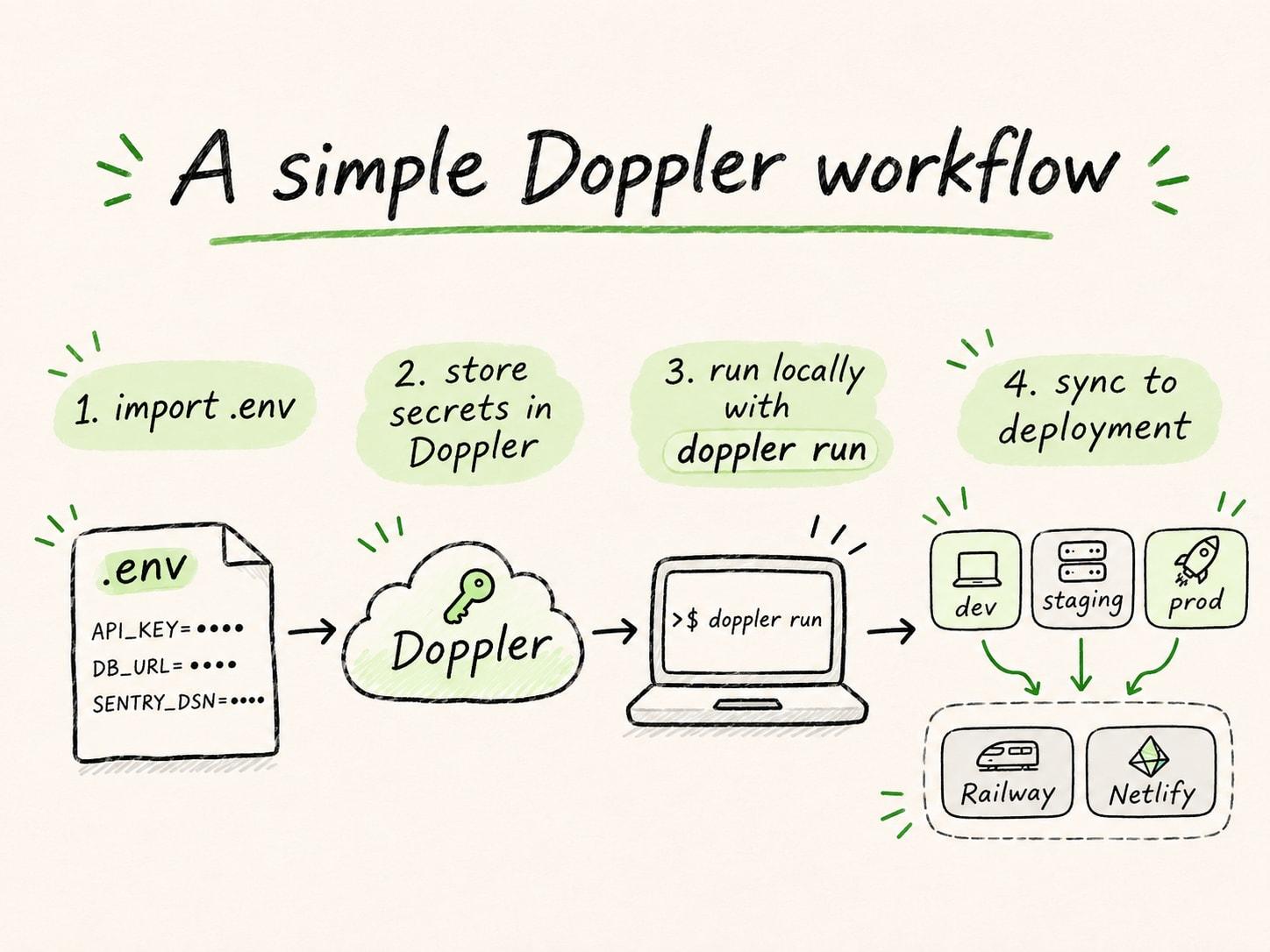
Now I can manage my environment variables from one place. Whenever I switch computers, I can use the same Doppler configuration.
For example, after setting up the project, I can start my application with: doppler run -- npm run dev
Doppler provides the environment variables to the application. I don't need to maintain separate local .env files. And that's my favorite thing about it.
When Is dotenv Enough?
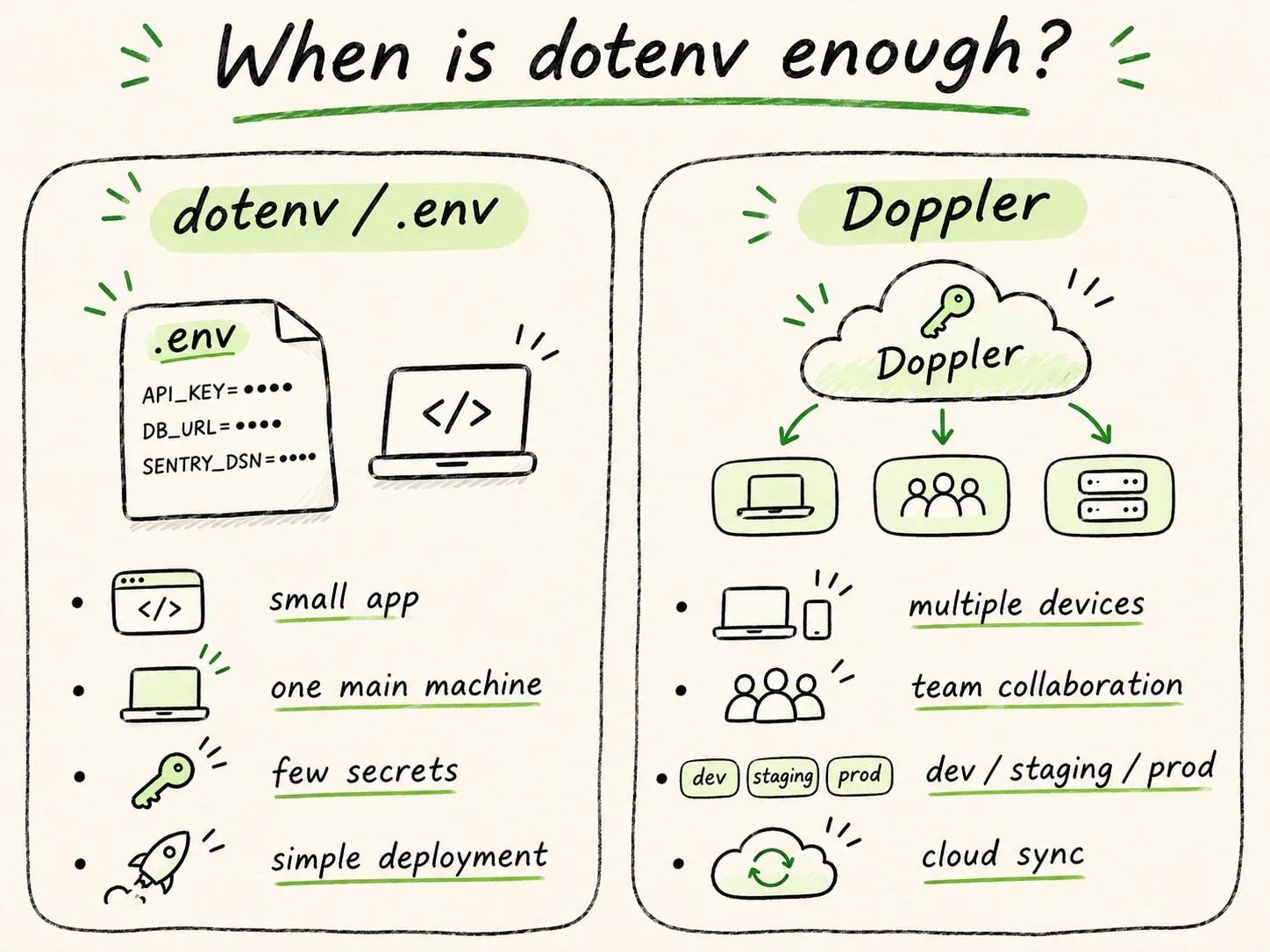
I still think dotenv or regular .env files are perfectly fine for many projects. If we're working on a small application, using one computer, and don't have many environment variables, I don't see much benefit in introducing another service. Even for production applications, we can use .env files for local development and configure secrets directly in our hosting provider.
For example, if we're building a simple Next.js website and deploying it to Netlify, using .env.local for development and Netlify's environment-variable settings for deployment might be enough. There's no need to complicate things unnecessarily.
When Does Doppler Make More Sense?
I think Doppler becomes more useful when managing environment variables starts taking unnecessary effort.
For example, when:
- We regularly switch between multiple computers.
- Several developers work on the same application.
- We maintain separate development, staging, and production environments.
- We deploy applications to multiple hosting providers.
- We frequently update credentials and want one central place to manage them.
Another thing I like is Doppler's integration with platforms like Railway and Netlify. Instead of updating the same secrets separately in different dashboards, we can configure Doppler to synchronize them.
Although, one thing to remember is that updating a secret doesn't necessarily mean an already-running application will immediately start using the new value. Depending on the deployment platform, we may need a rebuild or redeployment.
Is Doppler More Secure Than dotenv?
Doppler provides useful features for managing and controlling access to secrets. But that doesn't always mean our application is secure. For example, if we accidentally expose an API key through a NEXT_PUBLIC_ variable in Next.js, Doppler won't prevent that key from being included in client-side code.
Similarly, using .env files isn't automatically insecure. We just need to handle them properly, keep sensitive files out of Git, and avoid exposing credentials.
The main advantage of Doppler is centralized management and access control, rather than magically making every secret safe. And there is a trade-off. Doppler introduces another external service into our workflow, particularly when we depend on its CLI to retrieve secrets.
Which One Would I Choose?
For a simple project, I would probably continue using .env files. They're easy to manage, and sometimes that's all we need. But for projects where I regularly switch devices, work with other developers, or manage multiple deployment environments, I would prefer Doppler.
For my own workflow, Doppler has been very helpful. I no longer have to worry about keeping environment variables synchronized between my Linux desktop and MacBook. And I particularly like that I can use it for free for my current requirements.
If your current .env setup works well, there's no reason to replace it. But if managing environment variables is becoming frustrating, Doppler is definitely worth considering.
If you're interested in how I actually set up and use Doppler, I've written a more detailed article about it: Doppler Review: Managing Secrets from Development to Deployment.